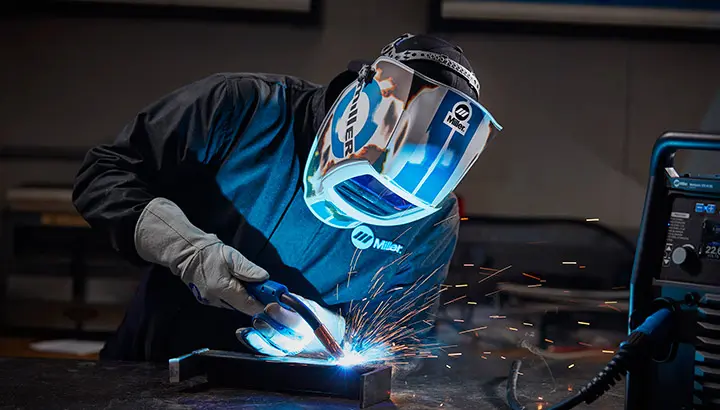
You finish a MIG weld expecting a clean, solid bead, only to find tiny holes, pits, or bubbles across the surface. That’s weld porosity—and it’s one of the most common problems MIG welders encounter.
Porosity occurs when gas becomes trapped in the weld metal as it solidifies. Besides making a weld look bad, excessive porosity can weaken it and may indicate a problem with your shielding gas, equipment, technique, or workpiece.
Fortunately, many causes of MIG weld porosity are relatively easy to identify and correct.
Here are seven common causes to check.
1. Incorrect Shielding Gas Flow
Your shielding gas protects the molten weld pool from oxygen, nitrogen, and other contaminants in the surrounding air. If you don’t have adequate gas coverage, atmospheric contamination can cause porosity.
But simply turning up the gas isn’t always the solution.
A flow rate that’s too low may provide inadequate coverage, while excessive flow can create turbulence that draws surrounding air into the shielding gas.
The appropriate flow rate depends on your equipment, nozzle size, welding conditions, and application. Follow the recommendations for your welder and shielding gas rather than assuming more gas is better.
2. A Leak in Your Gas System
If your flow meter says you’re getting enough shielding gas but you’re still experiencing porosity, check for leaks.
Leaks can develop around regulators, hoses, fittings, connections, and the MIG gun itself. A damaged O-ring or loose fitting may be enough to interfere with proper shielding.
Inspect your gas system periodically, particularly when changing cylinders or moving equipment.
A leak also wastes shielding gas, meaning you’ll go through cylinders considerably faster than necessary.
3. Wind and Drafts Are Blowing Away Your Shielding Gas
Your gas system can be working perfectly and still fail to protect the weld.
Why?
Air movement.
Fans, open doors, ventilation systems, and outdoor wind can blow shielding gas away from the weld pool before it can do its job.
This is particularly important when MIG welding outdoors.
If you’re experiencing unexplained porosity, pay attention to your surroundings. Even a draft that seems relatively minor can disrupt shielding gas coverage.
When possible, create a wind barrier or move the work to a protected area.
4. The Metal Is Contaminated
Dirty metal is another common source of weld porosity.
Rust, oil, grease, moisture, paint, coatings, and other contaminants can release gases when exposed to the heat of the welding arc. Those gases can become trapped inside the weld as it solidifies.
Clean the welding area thoroughly before starting.
Depending on the material and contamination, this may require grinding, brushing, or using an appropriate cleaner.
Starting with clean material doesn’t just help prevent porosity—it can also improve arc stability and overall weld quality.
5. Your MIG Wire Is Dirty or Contaminated
The workpiece isn’t the only potential source of contamination.
Your welding wire can also cause problems.
Wire exposed to moisture, dirt, oil, or corrosion can introduce contaminants directly into the weld pool.
Store MIG wire in a clean, dry environment and inspect it if you suddenly begin experiencing porosity after previously getting good welds.
If the wire is rusty or badly contaminated, replacing it may be easier than trying to salvage it.
6. Incorrect Gun Angle or Nozzle Distance
Technique matters.
Holding the MIG gun too far from the workpiece can reduce shielding gas coverage and expose the molten weld pool to the surrounding atmosphere.
An extreme gun angle can cause similar problems by directing shielding gas away from the area where it’s needed.
Keep the nozzle at an appropriate distance from the workpiece and maintain a consistent gun angle throughout the weld.
Also inspect the nozzle regularly.
Spatter buildup inside the nozzle can restrict or redirect gas flow, reducing shielding effectiveness even when your regulator is properly adjusted.
7. You’re Using the Wrong Shielding Gas
Different welding applications require different shielding gases.
For MIG welding carbon steel, argon/CO₂ mixtures are commonly used, with 75% argon and 25% CO₂ being one familiar option. Straight CO₂ is also used for certain MIG welding applications.
Other materials and processes may require different gases or mixtures.
Using an inappropriate shielding gas can affect arc characteristics, penetration, spatter levels, bead appearance, and overall weld quality.
If you’re uncertain about which gas is appropriate for your material, wire, and welding process, don’t guess. Check the recommendations for your equipment and consumables or talk with an experienced welding gas supplier.
A Quick MIG Porosity Troubleshooting Checklist
If you’re seeing holes or pits in your MIG welds, check these areas before changing your welder settings:
- Make sure the cylinder valve is open and you have adequate gas.
- Verify the shielding gas flow rate.
- Inspect hoses, fittings, and connections for leaks.
- Check the MIG nozzle for spatter buildup.
- Eliminate wind and drafts around the welding area.
- Clean the base metal thoroughly.
- Inspect the welding wire for rust or contamination.
- Check your gun angle and nozzle-to-work distance.
- Confirm you’re using the correct shielding gas for the application.
Working through these items systematically can often identify the problem quickly.
Don’t Overlook Your Shielding Gas
When MIG welds suddenly develop porosity, it’s tempting to immediately start changing voltage and wire-feed settings.
Sometimes the problem is much simpler.
Before making major adjustments to your welder, check your gas supply, flow rate, connections, nozzle, and working environment.
Good shielding gas coverage is essential for producing clean, consistent MIG welds.
Welding Gases and Supplies from Eureka Oxygen Company
Whether you’re welding in a fabrication shop, repairing heavy equipment, working on a vehicle, or tackling a project in your garage, having the right gas and welding supplies can make a significant difference.
Eureka Oxygen Company supplies welding and industrial gases, equipment, and welding supplies for professional and home welders throughout Northern California.
If you’re experiencing shielding gas problems or aren’t sure which gas mixture is right for your application, our team can help you choose the appropriate solution for your equipment and welding process.
Need welding gas or supplies? Contact Eureka Oxygen Company or visit one of our Northern California locations.
#MIGWelding #WeldPorosity #WeldingTips #WeldingProblems #WeldingGas #ShieldingGas #WeldingSupplies #MIGWelder #Welding #MetalFabrication #Fabrication #Welders #EurekaOxygenCompany #NorthernCalifornia #NorCalWelding