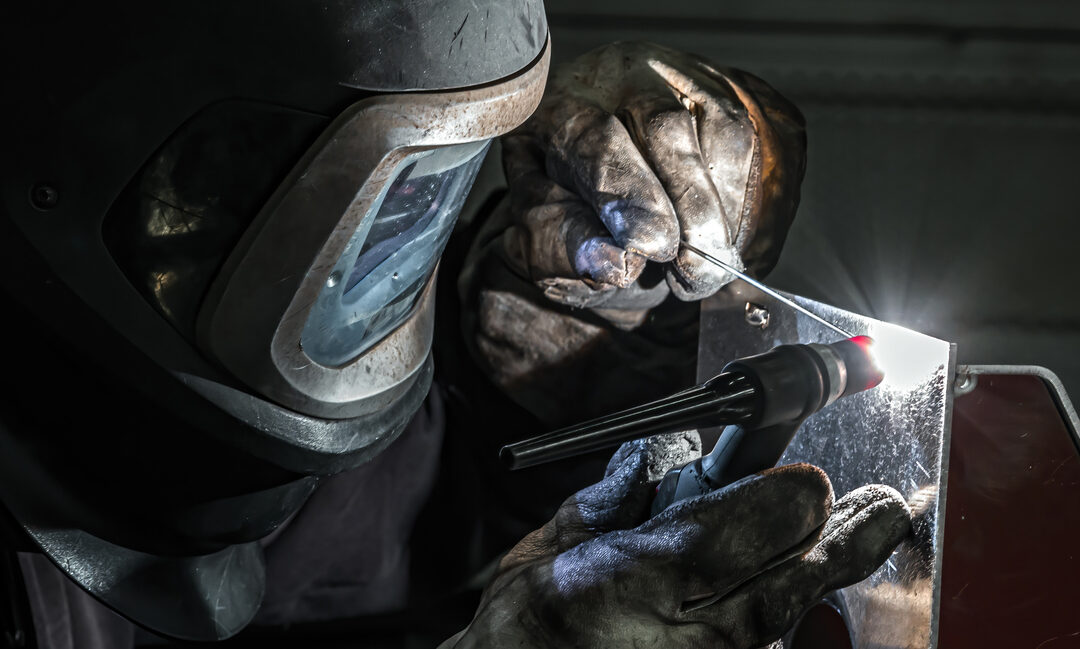
If you are transitioning from welding carbon steel to aluminum – or frequently switch between the two in your shop—you already know that aluminum doesn’t play by the same rules. While steel is forgiving and predictable, aluminum demands precise technique, meticulous surface prep, and a complete shift in how you manage heat.
Whether you are fabricating marine hardware for Humboldt Bay, repairing heavy logging equipment, or working on custom shop builds, mastering these core differences will save you hours of grinding, rework, and wasted materials.
1. Thermal Conductivity & Heat Management
The biggest physical difference between steel and aluminum is how they handle heat.
-
Steel: Steel has relatively low thermal conductivity. Heat stays concentrated near the weld zone, making it easy to establish a puddle and maintain a consistent travel speed.
-
Aluminum: Aluminum conducts heat nearly five times faster than steel. When you strike an arc on cold aluminum, the metal acts like a heat sink, rapidly pulling heat away from the joint.
Key Takeaway: You need significantly more amperage upfront to start an aluminum weld puddle. However, as the base metal heats up during the pass, you must speed up your travel rate or back off the foot pedal (in TIG) to prevent burn-through or heat buildup.
2. Oxide Layers & Surface Preparation
Pre-weld cleaning is non-negotiable for both metals, but the nature of their surface oxides is fundamentally different.
-
Steel Oxide (Mill Scale & Rust): Steel forms iron oxide, which melts at a lower temperature than the underlying steel. While mill scale should be ground off for critical welds, steel is relatively tolerant of minor surface contaminants.
-
Aluminum Oxide: Aluminum immediately forms a hard, invisible oxide skin when exposed to air. This oxide layer melts at roughly $3,700^\circ\text{F}$ ($2,037^\circ\text{C}$), whereas the raw aluminum underneath melts at just $1,220^\circ\text{F}$ ($660^\circ\text{C}$).
If you try to weld over aluminum oxide without cleaning it, you will melt the base metal underneath while the oxide skin floats on top, creating heavy inclusions, poor penetration, and a dirty puddle.
Aluminum Prep Checklist:
-
Degrease First: Clean the metal with solvent (like acetone) to remove oils or shop residue. Never wire brush before degreasing, or you will embed oils into the metal.
-
Dedicated Stainless Steel Brush: Use a clean, stainless steel wire brush reserved exclusively for aluminum to scratch away the oxide layer right before welding.
-
Never Use Steel Tools: Using a steel wire wheel previously used on carbon steel will drive iron particles into the aluminum, causing galvanic corrosion down the road.
3. Machine Setup & Polarity
You cannot use the same machine setup or gas for both materials.
| Feature | Carbon Steel Welding | Aluminum Welding |
| TIG Current Type | DCEN (Direct Current Electrode Negative) | AC (Alternating Current) |
| AC Balance Control | N/A | Adjusted for cleaning (EP) vs. penetration (EN) |
| Shielding Gas | 100% Argon (TIG), $75/25$ Argon/$CO_2$ (MIG) | 100% Argon or Argon/Helium blends |
| Tungsten Type | 2% Lanthanated or Ceriated (Pointed tip) | Pure, Lanthanated, or Zirconiated (Balled or blunted tip) |
| MIG Feed System | Standard drive rolls & steel liner | U-groove rolls, Teflon liner, or Spool/Push-Pull Gun |
Why AC for Aluminum TIG?
Alternating Current (AC) continuously cycles between Direct Current Electrode Negative (DCEN) and Direct Current Electrode Positive (DCEP):
-
DCEP (Positive Half-Cycle): Blasts away the stubborn oxide layer (cleaning action).
-
DCEN (Negative Half-Cycle): Directs heat into the base metal to achieve deep penetration.
4. Push vs. Pull Technique (MIG Welding)
When GMAW (MIG) welding steel, fabricators often switch between a push (forehand) or drag/pull (backhand) angle depending on joint position and desired penetration.
-
Steel MIG: Dragging produces higher penetration and a narrower, higher weld bead. Pushing creates a flatter bead with slightly less penetration.
-
Aluminum MIG: You must always use a push technique (a $10^\circ$ to $15^\circ$ travel angle leaning forward).
Warning: Dragging an aluminum MIG weld pulls the shielding gas away from the puddle, drawing in atmospheric contaminants. This results in heavy black soot (smut), porosity, and severely weakened joint strength.
5. Wire Feeding Mechanics (MIG)
Aluminum wire is far softer than steel wire. Trying to push a $.035″$ aluminum wire through a standard 10-foot MIG torch lead with V-groove drive rolls is a recipe for bird-nesting inside the drive roll cabinet.
To feed aluminum wire smoothly:
-
Replace steel V-groove drive rolls with smooth U-groove drive rolls to avoid crushing the soft wire.
-
Swap your steel torch liner for a Teflon or Nylon liner.
-
Keep your torch cable as straight as possible, or upgrade to a Spool Gun or Push-Pull Gun System for continuous, reliable feeding over longer distances.
Summary: Quick Comparison Reference
-
Heat Control: Steel accepts steady heat; aluminum requires high initial heat followed by rapid travel speeds as the workpiece absorbs thermal energy.
-
Surface Cleaning: Steel requires basic scale removal; aluminum demands strict solvent degreasing and exclusive stainless steel brushing to strip high-melting-point oxides.
-
Welding Process: Use DCEN and mixed argon/$CO_2$ for steel MIG; use AC and 100% Pure Argon (or Argon/Helium) for aluminum, always pushing the puddle.
Need shielding gases, spool guns, or wire for your next fabrication project? Explore our range of industrial gases and shop supplies at